This guide contains affiliate links. Details are at the end of the page.
Incline is the most common upgrade on walking pads. It is also the easiest to misunderstand. This guide explains what the percentages mean, how manual and automatic incline differ, and who benefits. It also compares the incline models on sale in Ireland. To compare incline models with flat ones, see walking pads in Ireland compared.
Key points
- Incline makes walking harder without making you walk faster, which is handy when your speed is limited by a desk or a short belt.
- “Manual 5%” usually means a fixed front lift that you set by hand before you start. “Auto 0–12%” means a motor you adjust mid-walk.
- Powered incline adds cost (about €70–120 on the models we compared), weight and another part that could fail.
- If you have joint, heart or balance concerns, ask your GP or physiotherapist before walking on a steep incline.
What does 5%, 12% or 15% incline mean?
A gradient percentage is the rise divided by the distance. A 5% incline rises 5 cm for every 100 cm travelled. That is roughly a gentle suburban hill. At 12–15% you are on a steep road that most people notice straight away in their breathing. On a walking pad, the front of the deck lifts. The short length of the deck means this can feel steeper than the number suggests.
Walking uphill takes more energy than walking on the flat at the same speed. Reference tables used by exercise scientists, such as the Compendium of Physical Activities, give higher intensity values for uphill walking than for level walking. The exact extra effort depends on your weight, speed and fitness. We do not put a percentage on it. Claims like “burn 30% more calories” in product images are marketing, not measurements.
Manual vs automatic incline
| Manual incline | Automatic (motorised) incline | |
|---|---|---|
| How it works | Fold-out feet or a lever lift the front to one fixed angle | A second motor raises the deck; you change it by remote or button |
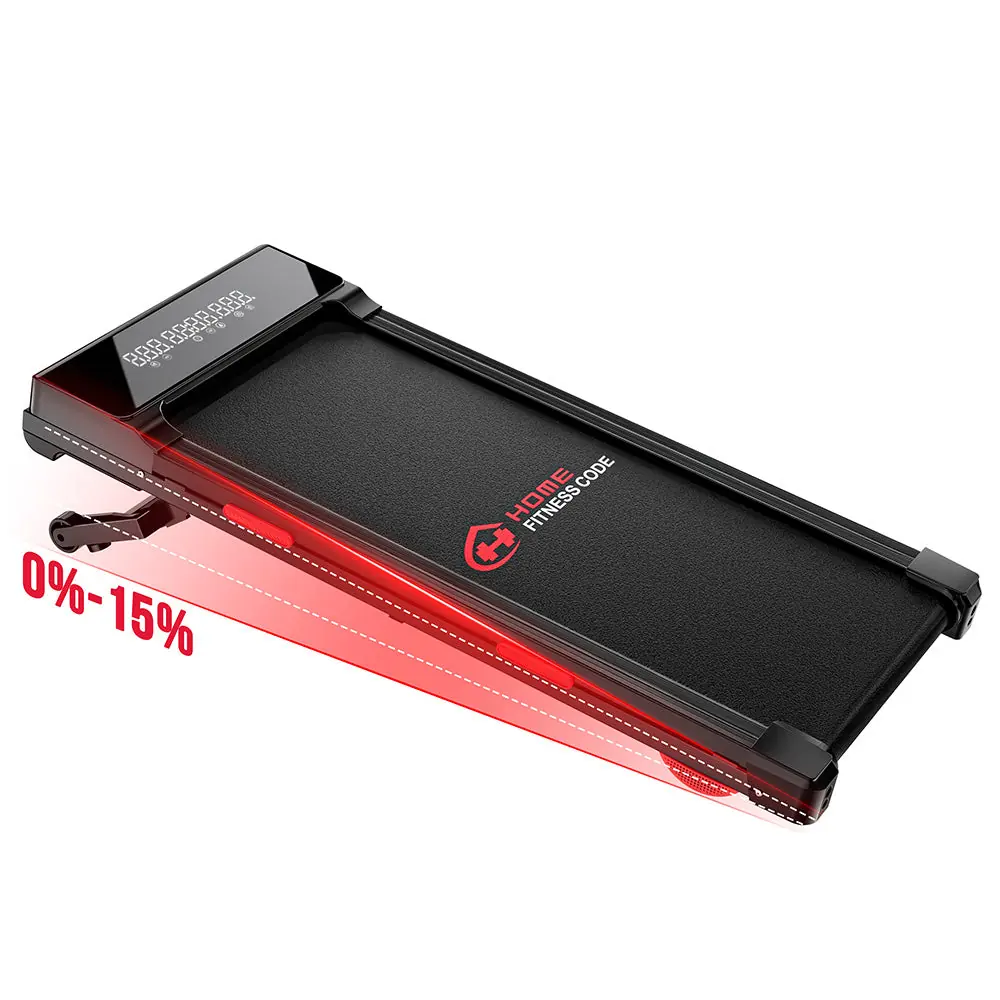
| Typical range | Around 5% (one setting) | 0–12% or 0–15%, in steps |
| Adjust while walking? | No: stop, step off and set it | Yes |
| Cost impact | Little or none | Adds to price and weight |
| Best for | People who want a slightly harder, constant walk | Interval-style walking and people who like to vary effort |
Incline walking pads on sale in Ireland

| Model | Price from* | Incline | Speed | Max user | Motor | Weight |
|---|---|---|---|---|---|---|
| Z3 | €109.99 | 5% manual | 1–6 km/h | 120 kg | Brushless, 2.5 HP peak | 13 kg |
| T7 | €99.99 | 5% manual | 1–6 km/h | 120 kg | Brushed, 2.5 HP peak | 16 kg |
| C1 | €99.99 | 5% manual | 1–10 km/h | 120 kg | Brushed, 2.5 HP peak | 17.5 kg |
| Y1 | €169.99 | 0–12% auto | 1–10 km/h | 145 kg | Brushed, 3.0 HP peak | 26 kg |
| Y3 | €199.99 | 0–12% auto | 1–10 km/h | 150 kg | Brushless, 2.5 HP peak | 21 kg |
| Y5 | €219.99 | 0–15% auto | 1–10 km/h | 150 kg | Brushless, 3.0 HP peak | 19.5 kg |
Our reading of the options
- Y5 (from €219.99): the widest stated range (15%), a brushless motor and a 150 kg limit, and lighter than the Y1. It is the most expensive option here. Y5 at Home Fitness Code
- Y3 (from €199.99): similar to the Y5, with 12% maximum incline and a slightly smaller stated motor. Y3 at Home Fitness Code
- Y1 (from €169.99): the cheapest powered incline. The trade-offs are a brushed motor, a higher noise claim (<50 dB) and the heaviest body at 26 kg. Y1 at Home Fitness Code
- Z3 / T7 / C1 (from €99.99–€109.99): fine if a single gentle slope is all you want. See our main buyer’s guide.
Who should skip incline
If you plan to walk slowly while typing, you may never use incline. Walking uphill at a desk also changes your posture relative to the keyboard. People who need to lift the pad under a bed every day may also prefer a lighter flat model. Anyone recovering from injury, or managing a heart, lung or joint condition, should get personal advice before adding gradient. Irish HSE guidance stresses that any movement is better than sitting, so a flat walk is still worthwhile.
Practical tips if you do buy one
- Start flat for a week, then add incline in small steps.
- Lower the incline before stepping on or off.
- Leave extra clearance behind the deck, because a raised front shifts your walking position backwards.
- Check that the remote has a clear “stop” button you can find without looking.
Frequently asked questions
Is 5% incline enough?
For many walkers a gentle 5% slope is a noticeable step up from the flat. If you want to change the effort during a session, you need powered incline.
Does incline make a walking pad louder?
The incline motor adds some noise while it moves. After that, noise depends mostly on the main motor, the belt and your floor. The retailer’s dB claims do not separate these.
Can I add incline to a flat walking pad?
Some people prop up the front, but manufacturers generally do not support this. It can stress the frame and may void the warranty. We do not recommend it.
How this guide was made: We have not tested these products ourselves. Our assessments use the specifications, prices and policies published by manufacturers and retailers. We checked them on 24 September 2026. Some links in this guide are affiliate links: Resolve Fitness earns a commission if you buy through them, at no extra cost to you. Read our affiliate disclosure and how we research.