
A walking pad needs far less care than a gym treadmill, but it is not maintenance-free. A few minutes every few weeks keeps the belt running smoothly and quietly, and helps you avoid warranty disputes. This guide pulls together what manufacturers and retailers publish. Your own manual always comes first, because models differ. Still shopping? Our walking pad Ireland guide lists models with their warranty terms.
Key points
- Unplug the pad and remove the safety key before any maintenance.
- Keep it clean: dust and grit under the belt cause wear and noise.
- Lubricate with 100% silicone oil only when your manual says. One maker, KingSmith (WalkingPad), recommends every 3 months.
- A belt that slips or drifts usually needs small, equal adjustments to the rear roller bolts, about half a turn at a time.
- A burning smell, grinding or repeated error codes mean stop and contact the retailer, not more oil.

Before you start: safety
- Switch off, unplug from the wall and remove the safety key or magnet.
- Let the motor cool if you have just used the pad.
- Keep children and pets away while the belt is loose or the pad is tilted.
- Do not remove the motor cover unless your manual tells you to. Opening it can affect the warranty.
1. Cleaning (every week or two)
- Wipe the belt, side rails and console with a slightly damp cloth, then dry. Do not spray liquid onto the pad or into vents.
- Vacuum around and under the pad. Dust, pet hair and carpet fibres get pulled under the belt.
- Check for anything trapped at the rear roller, such as hair ties or small toys.
- A firm mat under the pad keeps it cleaner and protects the floor. See our mats and flooring guide.
2. Lubricating the belt
The belt slides over a deck. A thin layer of silicone between them reduces friction, heat and noise. Too little lubricant makes the motor work harder. Too much can make the belt slip and attract dirt.
What to use
Use a 100% silicone treadmill lubricant. KingSmith’s guidance for its WalkingPad simply says silicone oil, and Decathlon’s treadmill advice specifies pure silicone fluid. Avoid household oils and general-purpose sprays unless your manual specifically allows them.
How often
Follow your manual. As an example, KingSmith recommends lubricating its WalkingPad belt every 3 months. Signs that it may be due include a new squeak, the belt hesitating under your foot, or the pad sounding louder than usual.
How to do it
- Unplug the pad. Loosen the belt enough to reach under it: on foldable pads KingSmith suggests lifting one half so the belt slackens.
- Apply the lubricant to the deck under the centre of the belt, not on top of the belt.
- Quantities vary with the size of the machine. KingSmith says 1–2 drops for a WalkingPad. Decathlon’s advice for folding treadmills is about 10–15 ml along each side of the deck.
- Re-centre the belt, plug in and walk slowly for a few minutes to spread the oil. Decathlon suggests about 2 km/h for 3 minutes.
3. Belt tension and centring
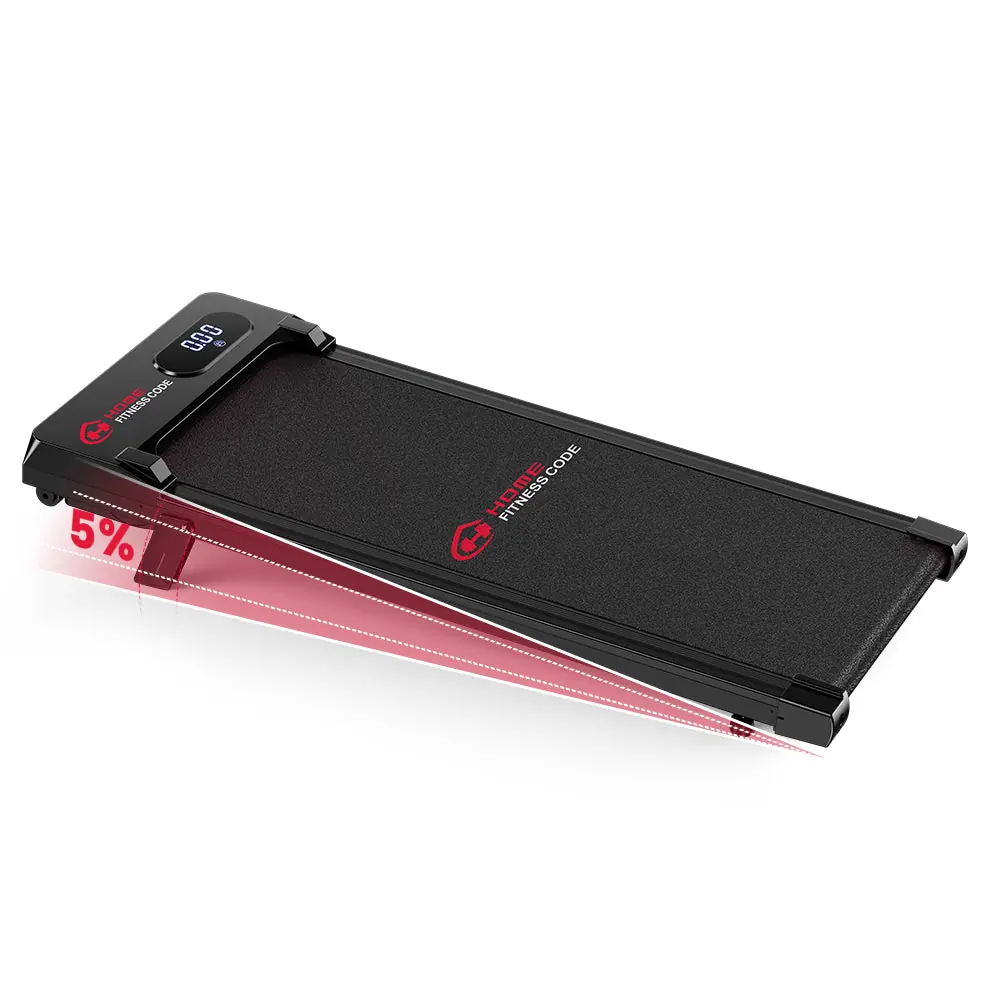
Belts often loosen slightly in transport and during the first weeks of use. Home Fitness Code’s product guidance describes this routine: run the pad briefly with nobody on it; if the belt is still loose, turn both rear adjustment bolts clockwise in equal half-turns; make sure the pad stands flat with its feet and wheels on the floor; then let it run empty for about 10 minutes to check.
- Belt slips when you step on it: tighten both bolts equally, half a turn at a time.
- Belt drifts to one side: on most treadmills you tighten the bolt on the side the belt is drifting towards, a quarter to half a turn, then re-check. Confirm the direction in your manual.
- Do not over-tighten. A belt that is too tight strains the rollers and motor. Stop as soon as the slipping stops.
Troubleshooting
| What you notice | Common cause | What to try |
|---|---|---|
| Squeaking or a louder hum | Dry deck, debris, pad not level | Clean, level the pad, lubricate if due |
| Belt hesitates or slips underfoot | Belt too loose, or too much lubricant | Tighten evenly; wipe off excess oil |
| Belt creeps to one side | Uneven tension or uneven floor | Level the pad; adjust one side slightly |
| Pad stops or shows an error code | Safety key, overload, overheating | Check the key and weight limit; see the manual |
| Burning smell, grinding or scraping | Possible motor, roller or belt fault | Stop, unplug and contact the retailer |
4. Storage and moving
- Store it where your manual allows: most pads are designed to be stored flat, for example under a sofa or bed.
- Avoid damp garages and sheds. Moisture is not good for electronics or the deck.
- Use the built-in wheels and lift from the correct end. Many pads weigh 20–26 kg.
- Plug directly into a wall socket rather than an extension lead, as most manuals advise.
Warranty and your rights
Keep your receipt and order confirmation. Stated warranties are often 12 months for budget pads. Using the wrong lubricant, exceeding the weight limit or opening the motor housing may give a retailer grounds to refuse a claim. If a pad develops a genuine fault, you also have statutory rights under Irish consumer law, separate from any warranty (CCPC).
Frequently asked questions
Do walking pads need oil?
Most do, occasionally. Check your manual: some makers specify a schedule, such as every 3 months for KingSmith’s WalkingPad, and some belts come pre-lubricated.
Can I use WD-40 on a walking pad?
Use the 100% silicone lubricant your manual specifies. General-purpose sprays are not designed for treadmill decks.
Why is my walking pad getting louder?
Common reasons are a dry deck, dust under the belt, a loose belt or an uneven floor. Clean and level it first, then check lubrication and tension.
How tight should the belt be?
Tight enough that it does not slip when you walk, and no tighter. Adjust both sides equally in small steps.
How this guide was made: We have not tested these procedures on our own machines. The guidance summarises information published by KingSmith (WalkingPad), Decathlon and Home Fitness Code, checked on 25 September 2026. This guide contains no affiliate links. Read our affiliate disclosure and how we research.