This guide contains affiliate links. Details are at the end of the page.
If you live in an apartment, or walk in an upstairs bedroom, noise is probably your biggest worry. The good news: walking is far quieter than running. The less good news: the figure on the box tells only part of the story. Here is how to think about noise before and after you buy. If you just want a shortlist, our guide to the best walking pads in Ireland ranks every model on price, noise claim and weight limit.
Key points
- There are two kinds of noise: airborne (motor hum, belt whirr) and impact (your footsteps travelling through the floor). Neighbours below mostly hear impact.
- Manufacturer dB claims cover the motor and are measured in unpublished conditions. Use them to compare models, not as a guarantee.
- A dense mat, slow speeds, soft-soled shoes and considerate timing reduce impact noise.
- Lower-noise claims in our comparison: Z3 (<30 dB), Q2 Pro, Y3 and Y5 (<35 dB).
Where walking pad noise comes from
- Motor: brushless motors are generally marketed as quieter than brushed motors. The noise claims below follow that pattern.
- Belt and rollers: a dry or mis-tracked belt gets louder over time. Regular lubrication, as per the manual, helps.
- Footfall: each step sends vibration into the floor. Timber floors and joists in older Irish houses can carry this surprisingly well.
- Rattles: handrails, remotes left on the deck, or an uneven floor can add knocks.
Lower-noise walking pads: published claims

| Model | Price from* | Stated noise | Motor | Speed | Max user |
|---|---|---|---|---|---|
| Z3 | €109.99 | <30 dB | Brushless | 1–6 km/h | 120 kg |
| Q2 Pro | €99.99 | <35 dB | Brushless | 1–10 km/h | 120 kg |
| Y3 | €199.99 | <35 dB | Brushless | 1–10 km/h | 150 kg |
| Y5 | €219.99 (sold out on 13 Oct) | <35 dB | Brushless | 1–10 km/h | 150 kg |
| T7 | €99.99 | <40 dB | Brushed | 1–6 km/h | 120 kg |
| C1 / Y1 | €99.99 / €169.99 | <50 dB | Brushed | 1–10 km/h | 120 / 145 kg |
If quiet is your main priority and you only walk, the Z3 makes the lowest claim of the models we compared. For a higher weight limit, the Y3 and Y5 pair brushless motors with 150 kg ratings.
Check Z3 price at Home Fitness Code
Check Y3 price at Home Fitness Code
Practical ways to reduce noise
- Use a dense mat. A firm rubber or treadmill mat reduces vibration and protects the floor. Avoid thick, soft foam that lets the deck rock.
- Walk, do not jog. Impact rises sharply with speed. Keep jogging for ground-floor rooms or outdoors.
- Choose your shoes. Cushioned trainers soften each footstrike. Walking barefoot or in hard-soled shoes is louder.
- Pick your times. Avoid early mornings and late evenings if someone lives below you. Some apartment management rules mention nuisance noise.
- Keep it maintained. Lubricate and centre the belt as the manual recommends.
- Talk to the neighbours. A quick chat, or a test walk while they listen, can prevent a complaint.
Storage in a small apartment
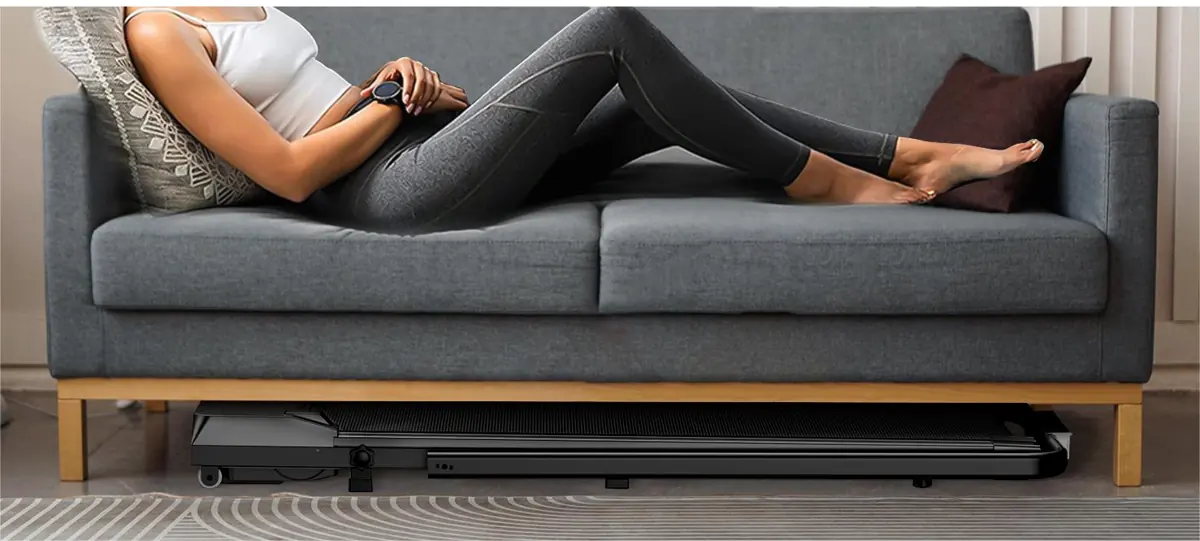
Most walking pads are 10–15 cm tall. Measure the clearance under your sofa or bed, and remember you will slide in a 13–26 kg box regularly. Flat, handrail-free versions are easiest to store. With some handrail versions, the rail must be unscrewed before folding.
What owners say
What owners say about noise. In about 2,900 written reviews on Home Fitness Code’s site (checked 13 October 2026), around 130 owners describe their walking pad as quiet, and only about a dozen say it was louder than expected, mostly for the brushed-motor C1 and T7 and the Q2 Pro. The Z3, which has the lowest noise claim, had 14 “quiet” mentions and one “louder than expected” among 339 written reviews. Reviewers judge noise from inside their own room, not from the flat below, so footfall through the floor is still the thing to plan for. See our full owner feedback analysis.
Frequently asked questions
Can downstairs neighbours hear a walking pad?
Often, yes, mainly as footstep thuds rather than motor noise. A dense mat, slower speeds and considerate timing reduce it. We cannot promise it will be inaudible in every building.
Is 30 dB actually quiet?
As a number, it describes a very quiet sound. However, retailers do not publish how or where they measured it. Treat the figure as a relative guide.
Should I put my walking pad on carpet?
Carpet can soften sound but may affect motor ventilation and stability. A firm mat on a hard floor is the usual manufacturer recommendation.
How this guide was made: We have not tested these products ourselves. Our assessments use the specifications, prices and policies published by manufacturers and retailers, together with an analysis of real owner feedback from retailer reviews, Trustpilot and owner forums (checked 13 October 2026). We checked them on 24 September 2026 and re-checked prices and stock on 13 October 2026. Some links in this guide are affiliate links: Resolve Fitness earns a commission if you buy through them, at no extra cost to you. Read our affiliate disclosure and how we research.